3. The Sustainability Discourse and Green Grabbing

My identity crisis: am I oppositional and do I resist power hierarchies, or do I reinforce inequalities?

The conversation around and implementation of climate change mitigation has predominantly focused on the shift from fossil fuels to renewable energy sources as well as an increase in energy efficiency; this can be observed in national and regional objectives like the EU’s 2020 renewable energy targets1 and in the endorsements of environmental organizations, such as WWF’s 100% Renewable Energy By 2050 report.2  Along these lines, scholars in the Ecomodernist Manifesto clearly advocated for technology as our fix to avert climate devastation, calling for the decoupling of economic development from environmental impacts by resource-efficient and carbon-neutral technologies.3 Although this reliance on technology, which might be attributed to techno-optimism, has been challenged4, the dominant discourse still seems to be centered around an energy transition rather than substantial changes in lifestyle and consumption patterns – or the rejection of the neoliberal order.5 6

[W]e have to change radically, but within the contours of the existing state of the situation … so that nothing really has to change!

Erik Swyngedouw7

Even though renewable energy projects “may be seen as oppositional, with decentralized models of generation and distribution that could broaden access, refigure consumption practices, and challenge hierarchies of power in energy markets,” large-scale developments such as the Ouarzazate Solar Plants, which build upon existing infrastructure, “may serve to perpetuate the inequalities and environmental damage associated with incumbent energy regimes.”8

Not an apolitical project; attracting tourism (the irony!) with carbon-neutral technologies. Tweet by Lahcen Haddad, the Vice President of the Society for International Development.

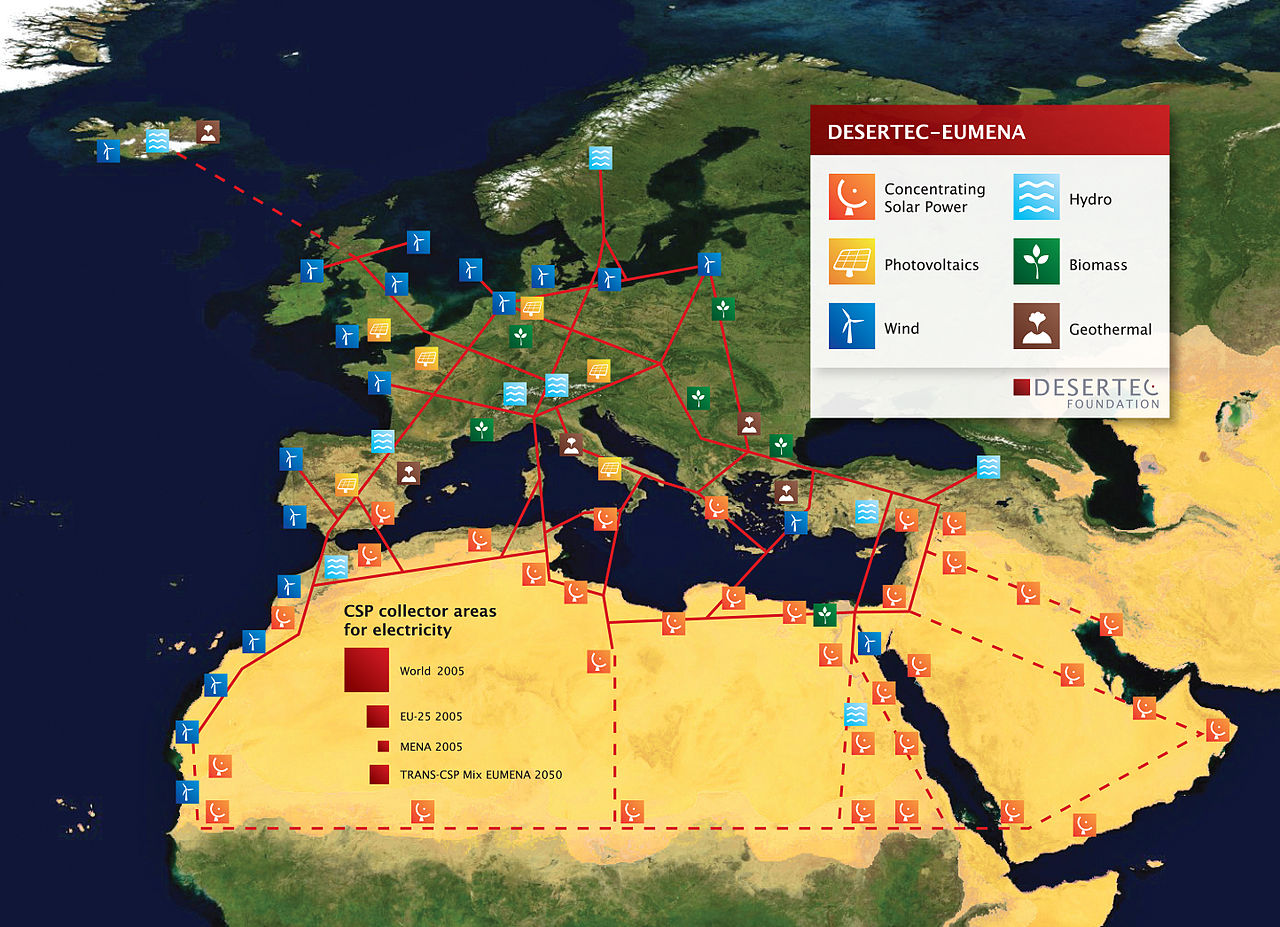
Cantoni and Rignall have argued that reports focusing on the potential of renewable energy, such as the ones produced by the International Energy Agency and the African Development Bank, obscure the ‘technopolitics’ in which projects like the Noor Ouarzazate plants and the Solar Plan more broadly are embedded.9 Technopolitics can be defined as the “strategic practice of designing or using technology to constitute, embody, or enact political goals”10 and it is in this context, backed by the sustainability discourse, that Morocco’s green turn should be understood. How the Ouarzazate project serves broader economic and governance goals becomes evident when considering its connections to transcontinental development concept of DESERTEC (Figure 1), which aimed to export solar energy generated in the Sahara to Europe, and received support from the European Parliament.11 Claiming that only 1% of the area of global deserts could satisfy the global annual energy demand12, the DESERTEC concept envisioned linking Europe with the MENA region to help Europe meet its renewable energy targets, and was framed as a win-win situation for all economies involved.13 Even though the plan to export energy to Europe was abandoned in 2013, it represents “the malleability of a technopolitics that can direct energy governmentalities to other governance goals”.14
undefined
Figure 1. Sketch of possible infrastructure for a sustainable supply of power to Europe, the Middle East and North Africa by DESERTEC.
Image by the DESERTEC Foundation, licensed under CC BY-SA 2.5, 2011.  

Technopolitics and the subsequent depoliticization of the Noor Ouarzazate project also raise important questions related to ‘green grabbing’. Green grabbing occurs when land and resources are appropriated in the name of environmental protection or sustainability, often transferring ownership from the poor into the hands of the powerful.15 This land could previously be owned privately or communally, and can be appropriated for a range of ‘green’ ends, such as biodiversity conservation or ecotourism. While the former claimants might not be completely banned from the area and its resources, green grabbing “does involve the restructuring of rules and authority over the access, use and management of resources, in related labour relations, and in human-ecological relationships, that may have profoundly alienating effects”.16 Specifically relevant to the case of the Ouarzazate solar plants is the logic of what Fairhead et al. refer to as ‘the economy of repair’ that underpins green grabbing: the notion “that unsustainable use ‘here’ [e.g. fossil fuel use in other parts of Morocco or Europe] can be repaired by sustainable practices ‘there’ [the generation of green energy in Ouarzazate], with one nature subordinated to the other.”17 This logic, combined with the framing of the land as marginal and underused, was pivotal in the land acquisition for the Ouarzazate project by the Moroccan government, which will be discussed in the next blogpost.

Solar power emerges in this context as a socio-ecological relation in which the fetishism of solar energy – especially its inexhaustibility, cleanliness, and immateriality – obscures the social relations necessary for its production.

Karen Rignall18

References
1. European Commission, No Date. “2020 Energy Strategy“.
2. World Wildlife Fund, 2011. The Energy Report: 100% Renewable Energy By 2050.
3. Asafu-Adjaye, J., Blomqvist, L., Brand, S., Brook, B., DeFries, R., Ellis, E., Foreman, C., Keith, D., Lewis, M., Lynas, M., Nordhaus, T., Pielke, R., Pritzker, R., Roy, J., Sagoff, M., Shellenberger, M., Stone, R. & Teague, P., 2015. An Ecomodernist Manifesto.
4. E.g. by Caradonna, J., Borowy, I., Green, T., Victor, P.A., Cohen, M., Gow, A., Ignatyeva, A., Schmelzer, M., Vergragt, P., Wangel, J., Dempsey, J., Orzanna, R., Lorek, S., Axmann, J., Duncan, R., Norgaard, R.B., Brown, H.S. & Heinberg, R., 2015. A Call to Look Past An Ecomodernist Manifesto: A Degrowth Critique.
5. Cantoni, R. & Rignall, K., 2019. Kingdom of the Sun: a critical, multiscalar analysis of Morocco’s solar energy strategy. Energy Research & Social Science, 51, pp.20–31.
6. Swyngedouw, E., 2013. The Non-political Politics of Climate Change. ACME: An International E-Journal for Critical Geographies, 12(1), pp.1–8.
7. Ibid.: p.4.
8. Rignall, K.E., 2016. Solar power, state power, and the politics of energy transition in pre-Saharan Morocco. Environment and Planning A, 48(3): p.542.
9. Cantoni, R. & Rignall, K., 2019. Kingdom of the Sun: a critical, multiscalar analysis of Morocco’s solar energy strategy. Energy Research & Social Science, 51, pp.20–31.
10. Ibid.: p.20.
11. Ibid.
12. TREC, 2009. Clean Power from Deserts: The DESERTEC Concept for Energy, Water and Climate Security.
13. Cantoni, R. & Rignall, K., 2019. Kingdom of the Sun: a critical, multiscalar analysis of Morocco’s solar energy strategy. Energy Research & Social Science, 51, pp.20–31.
14. Ibid.: p.24.
15. Fairhead, J., Leach, M. & Scoones, I., 2012. Green Grabbing: a new appropriation of nature? Journal of Peasant Studies, 39(2), pp.237–261.
16. Ibid.: p.239.
17. Ibid.: p.242.
18. Rignall, K.E., 2016. Solar power, state power, and the politics of energy transition in pre-Saharan Morocco. Environment and Planning A, 48(3): p.541.

4. The Land Acquisition: Green Narratives and Local Resistance

Or: How my generation can be used to extend state territory and marginalize communities.

As the previous blogpost enlightened, the construction of the solar plants implies that the previous land use was subordinate to the production of green energy. Several communities live in the vicinity of the Ouarzazate project, however, and used the land for grazing prior to the acquisition. This blogpost will discuss how the land was rendered as marginal and how the local population responded.

Ouarzazate, or The Door of the Desert: an important holiday destination as well as the set for many productions such as Gladiator and Game of Thrones.
Photo by Arne Hoel/World Bank, licensed under CC BY-NC-ND 2.0, 2012.

The project is situated on land that was communally owned by the Ait Oukrour Toundout ethnic group, 10 km north east of Ouarzazate. The Land Acquisition Plan characterized the proposed site as “pastoral land with low fodder resources”, which was deemed suitable for development because it would not require any population relocation.1 By constructing this land as marginal and underused2, officials drew from a history of environmental narratives, which commonly blame local pastoralists for land degradation.3 Davis describes how these environmental narratives of the arid parts of rural Morocco “justify the neoliberal goals of land privatization … in the name of efficiency and environmental protection”.4 The origins of this narrative can be traced back to colonial times, when the French administration in North Africa blamed Arab nomads for the deforestation of a purported Roman forest landscape, holding them responsible for subsequent desertification – even though the majority of this degradation has been caused by the colonial regime itself. These types of erroneous narrative persist, as they have been embraced by several post-colonial governments, such as those of Côte d’Ivoire, Guinea, and Algeria, and facilitate the control over land and resources. 5 6 By framing the extensive pastoralist land use as unproductive and by claiming that the power plants would have little impact on the environment, the government managed to extract value from these “marginal lands” for the greater good – obscuring unequal power dynamics and formulating local resistance as an attitudinal barrier to progressive development.7

Representatives of the Ait Oukrour Toundout community approved the land sale in October 2010. The project was opposed with much local resistance, however. The surrounding communities were not aware of the project before the land acquisition, and no official channels for impacting the decision-making process were made available for residents in the meetings that followed the land sale.8 A particularly painful issue was the fact that the land was sold for a relatively low price, which was possible because of the classification of the land as unproductive. Moreover, locals were furious that the sale proceeds would not directly benefit them: the revenue disappeared into an account managed by the Ministry of Interior, which could not be accessed by community representatives.9 Finally, residents questioned the other alleged benefits of the installation, such as the employment that they were promised. Opposition was expressed in letter writing and public complaints.10

“The project people talk about this as a desert that is not used but to people here it is not desert; it is pasture. It is their territory. The future is in land. When you take my land, you take my oxygen”

Community activist, cited in Karen Rignall11

Government officials who were met with the local resistance subsequently formed the residents’ claims to the land into issues of community development. Rather than making them direct stakeholders in the project, the communities were appeased with development projects such as road paving, tourism projects, and the distribution of bikes; projects which were in fact partially funded by the land sale revenues.12 These events bear stark resemblance to foreign investment for safari tourism in Loliondo, Tanzania, where Maasai were dispossessed of their lands in the name of conservation, and whose concerns were met with development projects such as the installation of a borehole and water well, support for local schools, and the funding of a women’s collaborative.13

The acquisition of land for the Ouarzazate project reflects several important and recurring themes. It demonstrates how powerful the framing of landscapes and environmental narratives are, and how they enable the Moroccan government “to secure control over marginalized populations and the economic rents embedded in their land.”14 In this context, technopolitics clearly obscure the capital accumulation and state territorialization goals in which the Ouarzazate solar project is embedded.15 Moreover, the land was entangled in a struggle over meaning: whereas it represented vital livelihood resources for the local population in the form of grazing land, it represented an untapped economic source for government officials, and an opportunity for European countries to get closer to fulfilling their renewable energy targets. Finally, it shows how political claims to land can be transformed into problems of development, for which government officials provide local projects instead of acknowledging the residents’ (rightful) claim to the land.

References
1. Kingdom of Morocco, 2011. Ouarzazate Concentrated Solar Power Project: Land Acquisition Plan (LAP), Executive Summary: p.6.
2. Rignall, K.E., 2016. Solar power, state power, and the politics of energy transition in pre-Saharan Morocco. Environment and Planning A, 48(3): p.541.
3. Davis, D.K., 2006. Neoliberalism, environmentalism, and agricultural restructuring in Morocco. Geographical Journal, 172(2), pp.88–105.
4. Ibid.: p.89.
5. Leach, M. & Fairhead, J., 2000. Fashioned Forest Pasts, Occluded Histories? International Environmental Analysis in Western African locales. Development and Change, 31, pp.35-59.
6. Davis, D.K., 2006. Neoliberalism, environmentalism, and agricultural restructuring in Morocco. Geographical Journal, 172(2), pp.88–105.
7. Rignall, K.E., 2016. Solar power, state power, and the politics of energy transition in pre-Saharan Morocco. Environment and Planning A, 48(3): p.541.
8. Ibid.
9. Ibid.
10. Ibid.
11. Ibid.: p.551.
12. Ibid.
13. Gardner, B., 2016. ‘Chapter 5: Nature Refuge’ in Selling the Serengeti: The Cultural Politics of Safari Tourism. Athens, GA: University of Georgia Press.
14. Rignall, K.E., 2016. Solar power, state power, and the politics of energy transition in pre-Saharan Morocco. Environment and Planning A, 48(3): p.541.
15. Cantoni, R. & Rignall, K., 2019. Kingdom of the Sun: a critical, multiscalar analysis of Morocco’s solar energy strategy. Energy Research & Social Science, 51, pp.20–31.